When your Google ranking is no longer enough
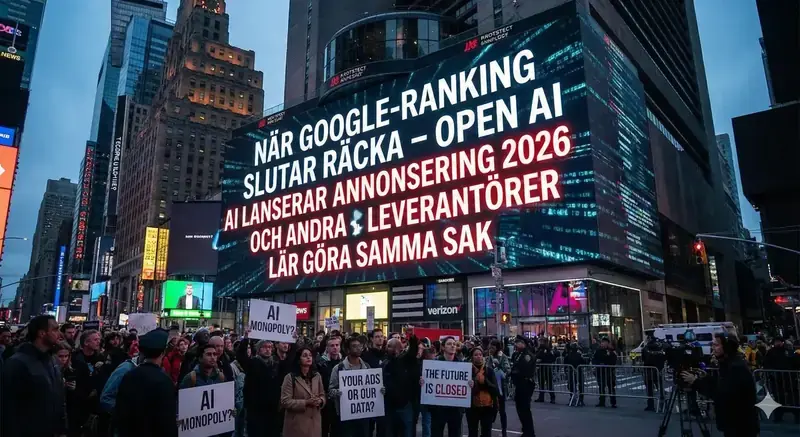
OpenAI is launching ads in ChatGPT in 2026. With 800 million weekly users and only ten million paying for a subscription, they have to make money from the free users. Internal documents show they expect to bring in one billion dollars from ads in the first year alone.
This is not just another ad channel to test. This changes how B2B buyers find information and make decisions.
Picture this scenario
A decision-maker at a growth company opens ChatGPT. Types: "Which CRM partner should we choose for our implementation?" The AI analyzes the question, checks earlier conversations, understands the context. Then it gives an answer with five recommendations, complete with cases, strengths and when each fits best.
Your company ranks in the top three on Google for relevant keywords. You spend SEK 70,000 a month on ads. But in that answer from ChatGPT? You are not mentioned.
It is not because the AI has anything against you. It is because it finds nothing worth citing. Your product sheets from 2019, your generic case descriptions, your "we are experts in" copy are not enough when the AI is looking for documented substance.
That happens in twelve months. Thousands of times every day.
A completely different business model
Google makes money when the search does not give you the answer directly. You click an ad, visit a site, maybe go back and search again. ChatGPT makes money when the AI gives you the right answer with sponsored content integrated into the conversation. No click is required until you actually want to act.
When the buyer no longer googles but asks the AI directly, your SEO ranking matters less. What counts is whether you have something worth citing.
And your customers are already making decisions there. They ask ChatGPT for recommendations, compare options, seek advice. If your data is not structured, your content lacks substance and your processes are not documented, you do not exist in those conversations.
A pattern I have seen before
After twenty years of CRM implementations and RevOps, I have seen the same thing happen three times when buyers change how they search for information:
When Google AdWords launched in 2000, the companies that connected their ads to CRM systems and could measure what worked won. The others wasted money for five years before they caught on.
When marketing automation became standard around 2010, the companies with clean data and documented processes won. Those running on Excel lists and ad hoc campaigns could not keep up.
Now it is happening again. But faster. And the gap between those who are prepared and those who are not will become very clear.
How ChatGPT ads work
Google Ads is built on keywords and auctions. You pay for clicks. Targeting is based on what someone typed in the search box. It is direct, measurable, predictable.
ChatGPT ads work differently. The system analyzes the context of the whole conversation, not just the question but what the user said before, which problem they are trying to solve, where in the decision process they are. Ads appear naturally in the conversation when they are actually relevant.
OpenAI is currently building infrastructure for campaign management and ad integration. Pricing will probably follow CPC or CPA models. But targeting happens through contextual analysis, not keyword matching.
Sam Altman, who earlier called ads a "last resort", has changed his stance. He now talks about ads that can actually add value, like when Instagram shows you products you want. Internal documents show that OpenAI expects to earn one billion dollars from ads in the first year.
Three concrete changes
Content without substance becomes invisible
Your first place on Google is not enough when the question is asked directly to an AI. Generic descriptions and marketing fluff are not cited. The AI looks for cases with concrete results, documented methodology, actual numbers. If you do not have that, you do not exist.
The buying journey gets shorter
The old way: search, click, read, compare, contact three suppliers, get quotes, decide.
The new way: ask the AI, get a recommendation, contact one supplier.
If your sales depend on "getting a foot in the door" through five different touchpoints, you need to rethink. Fast.
Data gives a real advantage
ChatGPT ads do not use keyword targeting. The system analyzes the full context of the conversation with history, preferences, earlier interactions. Companies with well-structured customer data, documented buying behavior and integrated systems can reach the right people in the right context. Those with Excel lists and guesswork cannot.
Three questions that decide whether you are ready
Answer these honestly:
Do you have data?
Open your CRM. Can you in five minutes identify your twenty most profitable customers AND see their whole buying journey from first contact to close? Which challenges they had, how you solved them, which results they got?
Yes means you have data. No means you are guessing.
Do you have content?
Search Google for "[your service] + case study + [your city]". Do YOU show up in the top five with actual projects, concrete results and numbers that show impact?
Yes means content worth citing. No means invisibility to AI.
Do you have processes?
If your best salesperson quits tomorrow, can a new colleague pick up exactly where the last one left off without asking anyone? Are your methods, your approach, your lessons documented and accessible?
Yes means processes. No means institutional memory in people's heads.
Three no's mean twelve months to fix the basics before ChatGPT ads launch.
Two no's mean eight months. Start with data.
One no means six months. You will make it, but without much margin.
Zero no's means you belong to the minority. Keep documenting and refining.
Why this is happening now
OpenAI burns three to four billion dollars a year running ChatGPT. They have 800 million weekly users but only ten million who pay. The economic reality is simple: they have to make money from the free segment.
They have learned from Google's mistakes. No banners. No pop-ups. No intrusive ads. Instead, natural advertising where the sponsored content is actually useful in context, like when you ask an experienced colleague for advice and get a recommendation built on real experience.
Perplexity AI has already been running ads since November 2024. Google Gemini is testing sponsored content in AI answers. ChatGPT simply becomes the biggest player with the widest reach.
The gradual shift
Google is not going away. It will keep dominating quick searches: opening hours, prices, directions. But for complex B2B decisions where the buyer needs advice rather than a quick answer, conversational AI is taking market share.
It will not be a revolution overnight. It will be a gradual shift in how B2B buyers find information and evaluate suppliers. Companies that already have their data, their processes and their documented know-how in order will adapt in weeks. The others will panic in autumn 2025 and try to fix in three months what should have taken a year.
The difference is that those who arrive late to this cannot buy their way in. With Google Ads you can always raise the bid. With AI citations you must have something worth citing. You cannot fake it.
What you do now decides the result in 2026
This is not speculation. The behavior change is already under way. Your customers use ChatGPT for research, comparisons, decision support. When the ads launch, those who are prepared get a big advantage, not because they spend the most but because they have built the foundations right.
The question is not IF this changes how your customers find suppliers. The question is whether you use 2025 to prepare or carry on as usual until someone in the leadership team asks "why are we never mentioned when people ask AI about our industry?"
I know what most will do. They wait until it happens, then try to fix it in a panic.
What will you do?