AI: it's everything, everywhere, all at once
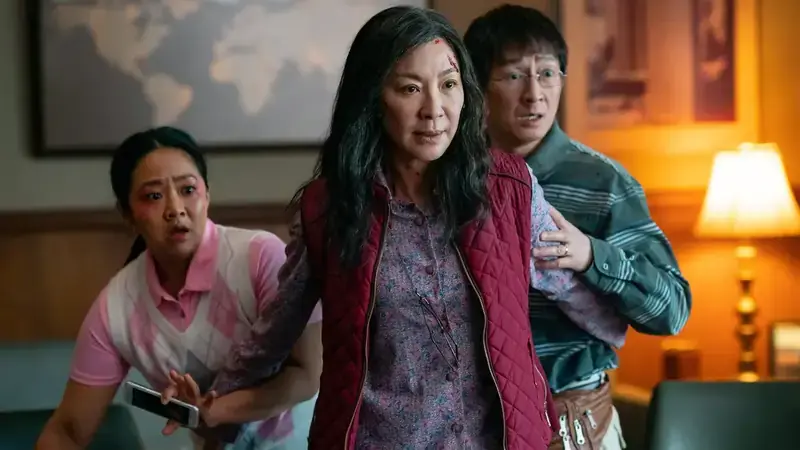
I often think about that scene in the film "Everything Everywhere All at Once" where Michelle Yeoh just stands there, in the middle of her laundromat, while information from a thousand different realities flashes past. She is trying to sort out her tax return, talk to her daughter, put away the laundry. At the same time she is bombarded with images from other lives she could have lived. In one she is an action star. In another she runs a restaurant. In a third she is, well, a rock with googly eyes on it (that scene is still sick).
The absurd thing is that the film captures exactly how I feel about AI right now. And I have been working with this for many years.
Something new every damn day
I have followed AI development for a long time. I have seen generations of models come and go. Tested tools at early stages, read research papers, given presentations. You would think I would be used to the changes by now.
But the past year? It is something else.
Two years ago I learned that ChatGPT could write emails. Okay, I thought, neat. Could save a bit of time. The week after, it could suddenly code websites. Then came image generators. Video clips from text. AI that designs, composes music, analyzes medical images, writes legal documents, even better video, even better x, y, z.
I barely have time to digest one piece of news before the next one appears. Just like Evelyn in the film jumping between realities, I wake up every morning to a new version of what is possible. And despite all my experience? It is damn tiring.
Yesterday I listened to a lecture from the Harvard Data Science Review. Top researchers, people who are deep inside this. And you know what? Even they openly admitted they feel confused. One said outright: "We don't really know where this is heading anymore."
It was almost a relief to hear. Because if even the people who build the systems cannot predict what happens next month, how the hell are the rest of us supposed to keep up?
My friend who works in graphic design says the same thing. "I don't know whether I should learn the tools or whether my job is going away anyway." That is the feeling. Trying to keep up while the ground moves under your feet.
Who the hell are you, really?
(I have to admit I plagiarized this heading from Marc Hillander's podcast, Vad fan ska jag ha AI till (What the hell do I need AI for).)
There is a scene where Evelyn has to choose which version of herself to be. The successful artist? The small business owner who has struggled all her life? Who is she when all these lives exist at the same time?
I recognize that. Although with AI the questions are different. I have worked with AI for years, but now I face entirely new dilemmas every week. Should I use the latest model for everything it can do, or are there limits I should set? Is it cheating to let AI write certain things, or is it just a tool, like the word processor once was?
My child asked last week whether they could use ChatGPT for their maths homework. I, who give lectures on AI, stood there without an answer.
The reality seems to be that there is no simple answer. AI is both amazing and frightening. A tool and a threat. All at once. And we are somehow expected to navigate this chaos while still remembering to buy milk and pay the bills.
Everyone has an opinion (and nobody really knows)
The worst part is not the technology itself. It is the noise around it.
Someone says AI will save the world. Someone else shouts that it will destroy all jobs. A third claims we are five years from a superintelligence that will rule over humanity. A fourth rolls their eyes and says the whole thing is overhyped, like blockchain and everything else.
I read articles. Listen to podcasts. Test tools. Go to conferences. And mostly just feel more confused afterwards.
When I heard the researchers at Harvard talk openly about their uncertainty, I felt both relieved and worried. Relieved because I am not alone. Worried because if even the experts do not know, what do we do then?
It reminds me of that scene where Evelyn is completely overwhelmed. She cannot process everything. The brain cannot keep apart what is important and what is just noise. She just stands there, in the middle of the chaos, not knowing where to turn.
That is exactly where I find myself. Despite all my years in the industry. And I think many others do too, no matter how long they have worked with this.
What actually matters
But the film does not end in chaos. The beautiful thing is that Evelyn finally realizes something: she does not need to master all the realities. She only needs to find her way back to what actually matters. For her, that becomes family. The small moments of real connection. Love in the middle of chaos.
Maybe it is the same with AI. We do not need to understand everything. I do not need to keep up with every piece of news about the latest model or what the Silicon Valley crowd says on Twitter. And it is okay to admit confusion, even after working with this for a long time.
If AI makes the job easier, use it there. If something feels wrong, listen to that feeling. If you need to switch off the news feed for a week, do it. The world keeps spinning anyway.
At the end of the film, Evelyn learns to be present in her own life, even though a thousand other lives are calling for her attention. She chooses her reality instead of letting all the realities choose for her.
We can do the same. Acknowledge that AI is changing things without letting it turn us into nervous wrecks. Be curious without becoming obsessed. Careful without being paralyzed.
Because the most human thing, as the film shows, is not to know everything or be everywhere. It is to be able to choose what matters, even when a thousand voices pull us in different directions.
In the middle of all this technological chaos, that choice may be the most important thing we have left. Getting to decide where we put our attention. What we care about. Who we want to be.
And no AI can take that from us. Not even when development moves so fast that the experts themselves lose their footing.
#AI #HumansAndTechnology #future